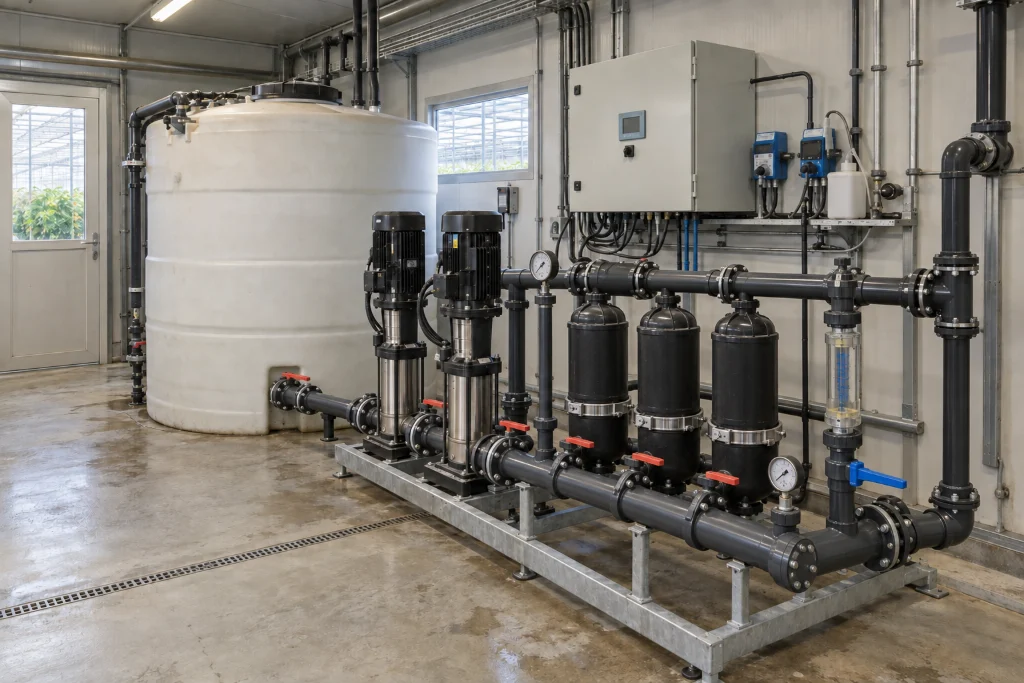
Biofilm in drip lines
Microorganisms can attach to the inner surfaces of pipelines and emitters, where biofilm can develop.
Water microbiology
Microbial formulations for professional use in water storage, recirculation and drip irrigation systems.
Microbiology in irrigation water
Irrigation water is never sterile. In water silos, reservoirs, pipelines and emitters, microorganisms are continuously active. They respond to temperature, organic load, retention time and the composition of the water.
Those microbial conditions help determine how stable a system behaves, from water quality in storage to flow through drip lines. Viewing the full water path as a biological environment makes it easier to manage for consistent conditions.
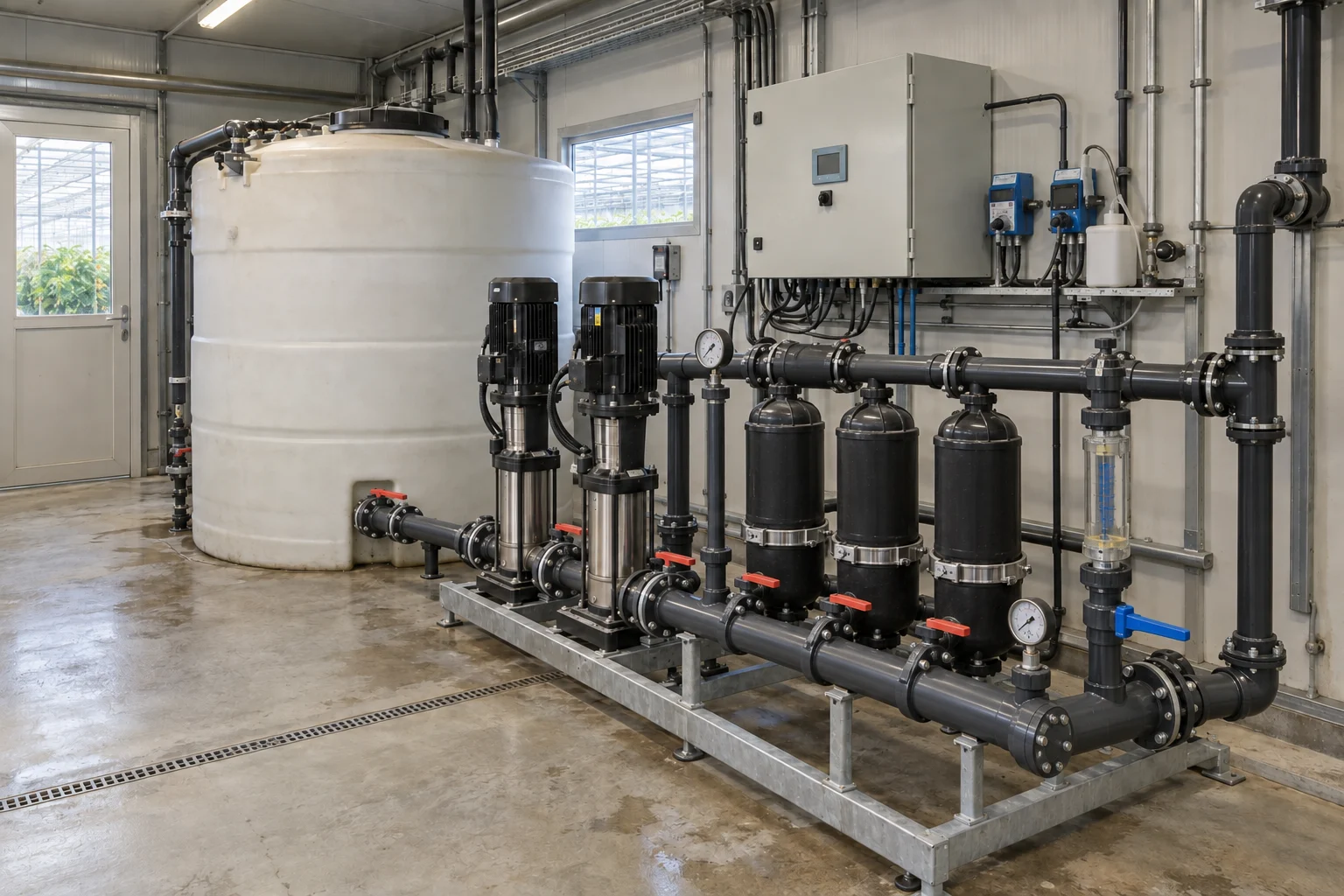
Familiar from practice
Biofilm in drip lines, uneven flow and shifting conditions in water storage are familiar situations. They rarely have a single cause, but microbiology is almost always part of the picture.
Microorganisms can attach to the inner surfaces of pipelines and emitters, where biofilm can develop.
Organic residues can accumulate over time in tanks, filters and irrigation lines.
Deposits and biofilm can restrict emitters, resulting in less even water distribution.
Microbial populations in stored water can fluctuate as temperature, water quality and organic load change.
Three types of clogging
A dripper with reduced flow can have several causes. Identifying the cause determines which action is appropriate and clarifies what a microbial approach can and cannot contribute.
Clogging in an irrigation system often results from a combination of biological, chemical and physical factors. That is why we consider the complete irrigation water system and help determine which approach fits your situation.
The water path
Microbial conditions change along the way. Water held in a silo behaves differently from water that has circulated through a recirculating pipe network for days.
That is why BIOMICROBES looks at the full water path and at the point where a microbial solution genuinely fits.
Our water solutions
DRIP LINE en WATER TREATMENT each work at their own point in the water path: one in distribution toward the emitter, the other in the stored water that feeds the system.
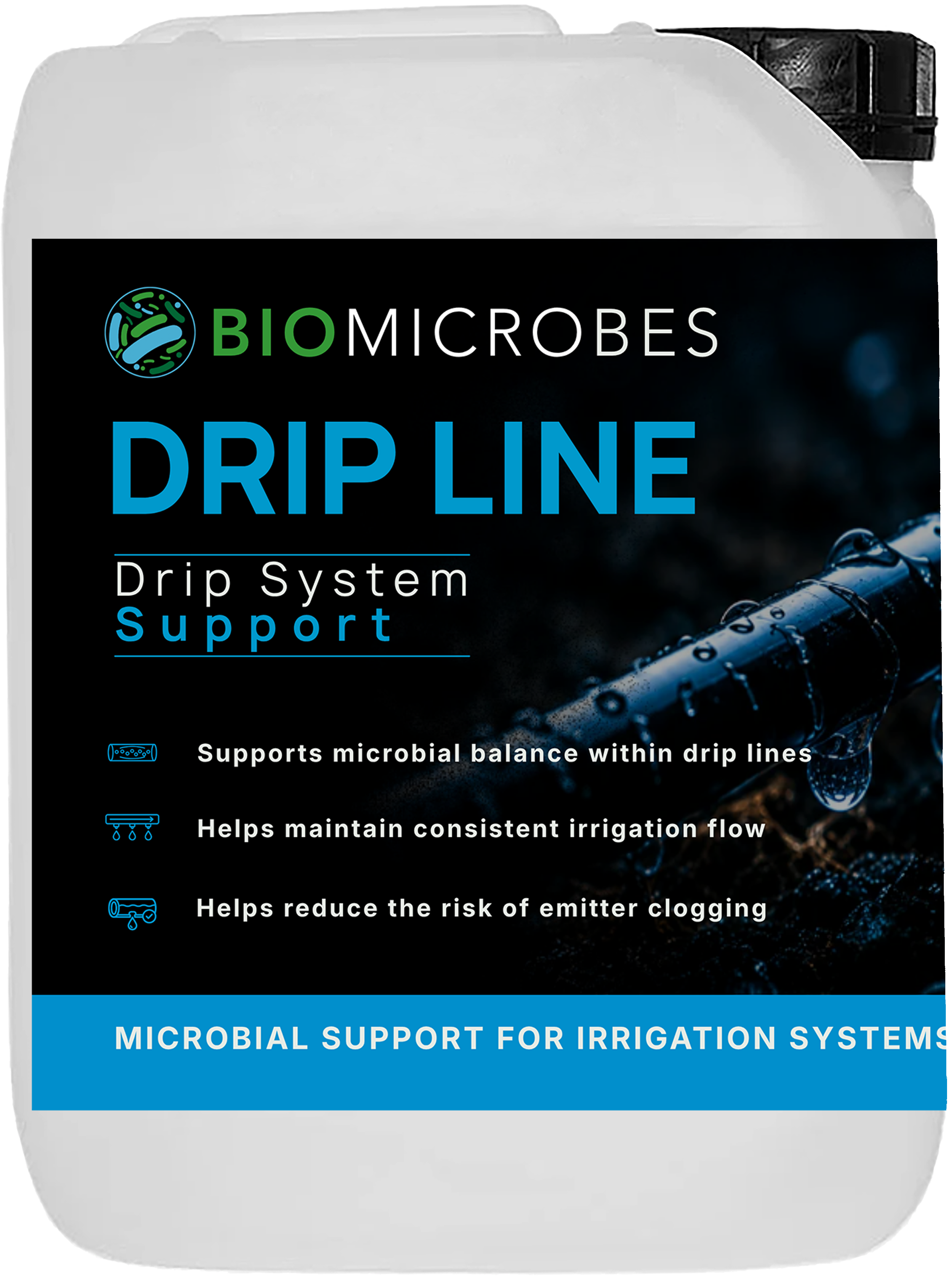 Drip irrigation
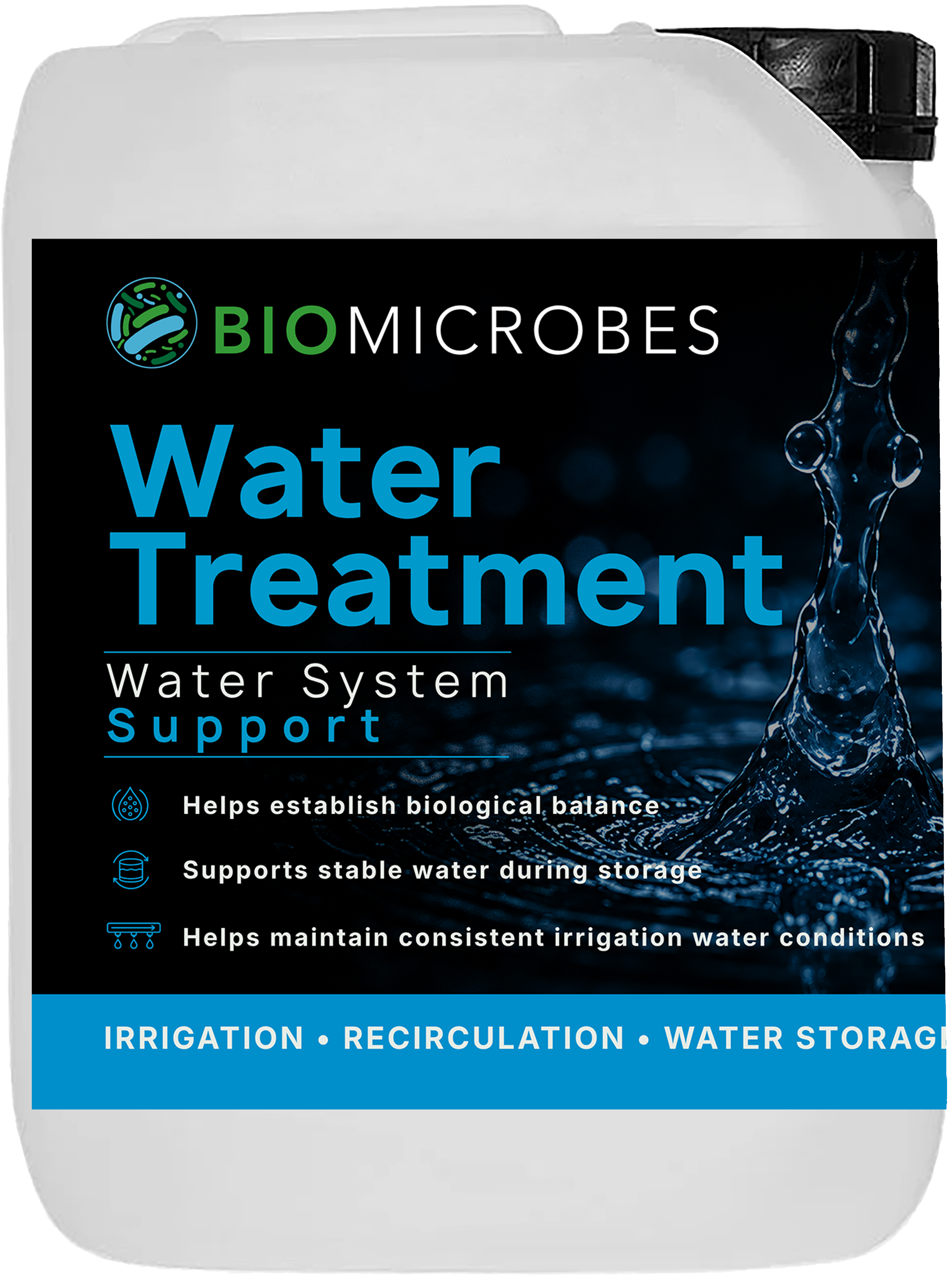 Water storage
Why BIOMICROBES
BIOMICROBES develops microbial formulations for irrigation and water storage in professional agriculture and horticulture. From product development and formulation to batch control and application guidance, quality and reproducibility are central to our approach.
Practical questions
Why microbiology in irrigation water matters and how water storage and drip lines differ.
There is no general rule that a lower pH is better. Acidity affects microbial growth, while species and strains have different limits. The crop and the nutrient solution also have requirements. Distinguish between the pH of the concentrate, the diluted solution and the root zone. Use a product-specific application range; a low pH in the bottle or a general growing value does not prove that efficacy is guaranteed.
pH describes the acidity at the moment of measurement. Alkalinity indicates how much acid the water can neutralize, partly due to bicarbonates. Two water sources with the same pH can therefore react differently to the same acid addition. Also have alkalinity and EC determined and, where needed, assess the individual salts. This lets you match water treatment more closely to the nutrient solution and the substrate.
Follow a mixing order that has been established for the combination. Mixing the microbial product directly with concentrated acid can temporarily create very different conditions from the final tank pH. A pH measurement afterward therefore does not tell you everything about the exposure during mixing. Have a product-specific mixing order confirmed in advance, stating how the water is prepared and when the product is added.
You cannot infer that from the name of the bacterium. Filters differ in how they work, and the formulation may contain particles or aggregates. In addition, an ordinary particle filter is not the same as a membrane that retains microorganisms. Map the filter type, filtration rating and injection point, and have the product’s suitability checked. Do not remove or bypass necessary filtration based on a general assumption.
That requires coordinating the application route. Disinfection can also affect the added microorganisms. Map where the treatment is located, whether the water passes through that step again and whether an active agent remains after treatment. Use this to determine the injection point and application timing. Do not simply switch off a necessary disinfection step; there is no general waiting time that applies to all systems and products.
Microorganisms can attach to a surface in a protective layer. Around a root, such an organization can contribute to the establishment of certain bacteria. In an irrigation line, buildup can be undesirable. What it means depends on the location, composition and consequences. So do not automatically use “biofilm” as a synonym for contamination, and do not infer a cleaning effect in lines from root colonization.
Mixing and application
A concentrated A or B stock tank requires a different assessment than diluted nutrient solution. In that tank, the salt concentration and sometimes the acidity are much higher. Suitability in the final tank therefore does not prove suitability for the stock tank. Have the exact fertilizers, dilution, residence time and microbial formulation assessed before dosing them together in one stock tank.
A jar test can reveal visible problems such as flocculation, precipitation or separation. It does not tell you whether the bacteria remain viable or whether both products retain their function. For microbial products, physical mixability, biological compatibility and crop safety are separate assessments. So check what a compatibility statement has actually tested.
The shelf life of a closed concentrate does not automatically apply to a diluted solution. After dilution, conditions change and added inputs can affect viability. Only prepare a batch in advance when product-specific stability data are available. Have it confirmed how much time is allowed between mixing and application, and under which conditions.