
EC is on target. pH sits comfortably within range. Yet the filter clogs faster than usual, some emitters deliver less water, or the crop doesn’t respond evenly across the greenhouse. Sound familiar?
It’s tempting to look for a single cause. But irrigation water rarely has just one story to tell. The cause may be chemical, such as mineral precipitation. There may be particles in the water. System hardware, temperature, organic matter and microorganisms can all play a part too. Often, it’s a combination.
If you only look at EC and pH, you’re seeing just part of the system.
Clear water isn’t automatically stable water
Water can look perfectly clean and still carry a lot you can’t see: dissolved salts, very fine particles, organic compounds and microorganisms. And water changes along the way.
The water at the source isn’t necessarily the same water that reaches the roots. Storage in a basin or tank, fertilizer injection, temperature swings, recirculation and residence time all affect the system.
Research in commercial tomato greenhouses (opens in a new tab) also shows that microbial communities can differ considerably between water sources, storage methods and farms.
That’s why a single sample from a single point says little about the whole water line.
What exactly is biofilm?
Microorganisms don’t only float freely in water. Some attach to wet surfaces, such as the inside of pipes, filters and emitters. There, together with organic matter, they can form a thin layer: a biofilm.
Biofilm formation is a normal biological process. The presence of biofilm doesn’t automatically mean a system is contaminated or unhealthy.
Problems can arise when the layer grows heavily, or when microorganisms, organic matter, mineral deposits and suspended particles build up together. In narrow passages, that can affect water delivery.
Research on drip irrigation with reclaimed water (opens in a new tab) shows that biofilm and the particles trapped in it can be linked to lower and less uniform emitter discharge. That study looks at a specific type of water and doesn’t translate one-to-one to every growing system. Above all, it shows why a proper diagnosis matters.
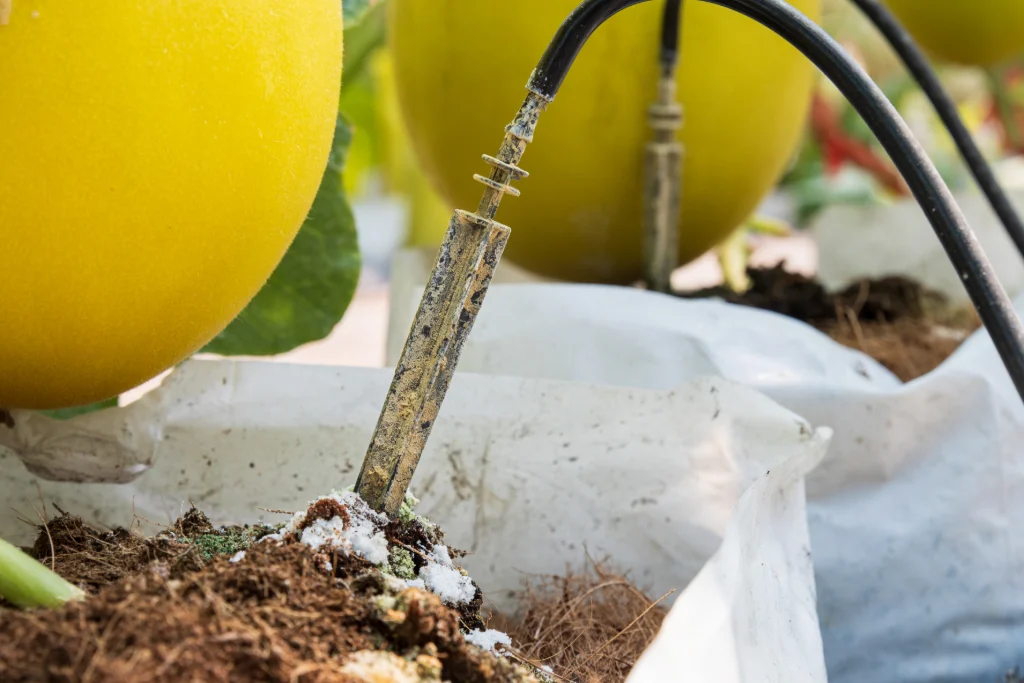
Not every blockage has a biological cause
An emitter that delivers less water doesn’t prove that microorganisms are to blame. Blockages can also come from sand, clay, rust particles, root intrusion or chemical precipitation.
It can even be a combination: an existing biofilm can trap particles while mineral deposits narrow the passage further.
So look beyond the symptom and pay attention to the pattern:
- Does the problem mainly occur at the end of lines?
- Are certain zones, irrigation cycles or seasons more sensitive?
- Does the pressure drop across the filter build up faster?
- Do problems return shortly after maintenance?
- Is there visible sediment, scale or a slimy layer?
- Does discharge differ between the start and the end of a line?
These signals don’t tell you the solution yet. But they do help you look in the right place.
Follow the full route from source to root
A useful water analysis doesn’t start with a single result, but with a map of the system. Follow the water from the source through storage, fertigation and disinfection to the main line, drip line, emitter and, where relevant, the return flow.
Then choose sampling points before and after components that can change the water, such as the basin, mixing tank, filter, disinfection unit and the end of a line.
Ideally, compare results over several moments. A system behaves differently on a hot afternoon than right after a basin has been filled or after a long standstill.
Depending on the situation, relevant data may include:
- pH, EC and alkalinity;
- the mineral composition of the water;
- temperature and dissolved oxygen;
- turbidity, suspended particles and organic load;
- pressure, flow rate and differences in discharge;
- microbiological measurements that match the specific question.
Not every parameter needs to be measured every time. The key is to ask the right question first. Is it about safety, crop health, fouling, uneven delivery or recurring maintenance? That question determines which measurements make sense.
Water microbiology isn’t a simple split between “good” and “bad”
Water is home to many different microorganisms. What they mean for your system depends on the species, their numbers and the conditions they end up in. Temperature, nutrients, oxygen, flow and the maintenance or disinfection regime all play a role.
That’s why “adding more good bacteria” isn’t a complete water strategy. Nor is completely sterile water a realistic or necessary goal in every growing system.
It’s about control: a system that fits the water source, the crop, the hardware and the way the operation is run.
A biological application can be part of such a maintenance strategy, but it doesn’t replace proper filtration, hygiene, technical checks or good monitoring. It also needs to be assessed beforehand how an application interacts with, for example, disinfectants, fertilizers, temperature and residence time.
From quick fixes to structural water management
When a problem becomes visible, a quick clean-out is sometimes necessary. But if the same fouling keeps coming back, cleaning alone is often not enough. The more important question then is: what conditions allow it to return?
Structural water management is therefore a coherent approach:
- Map the system. Know where the water comes from, how long it is stored and which treatments it receives along the way.
- Identify the real cause. Distinguish between physical particles, chemical precipitation, biological growth and technical faults.
- Choose suitable measures. Where needed, combine filtration, flushing routines, cleaning, disinfection, technical adjustments and biological support.
- Check the effect. Don’t just check whether a line is clean after treatment, but also whether pressure, discharge and water quality stay more stable.
This way of working prevents every fault from automatically getting the same treatment.